Creativity and Agency in the Age of AI and Action Automation
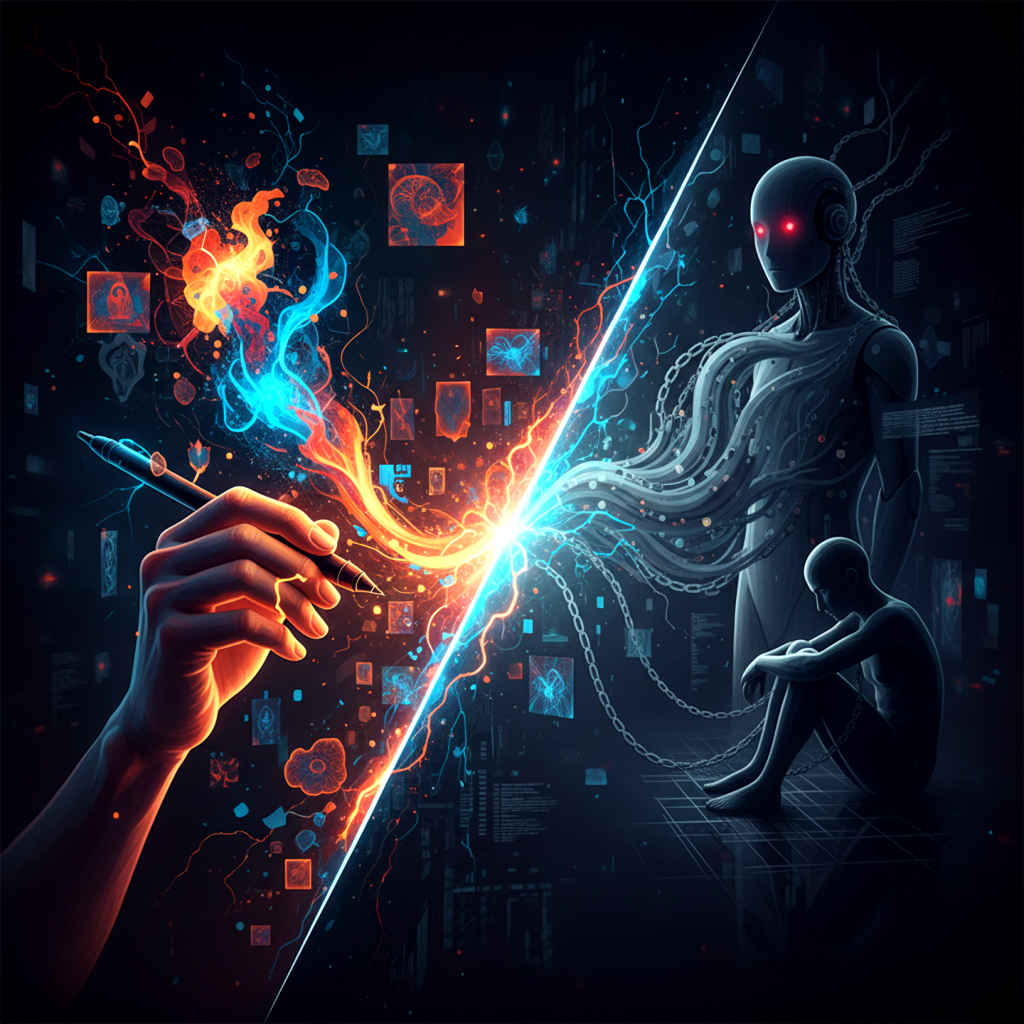
In an era where artificial intelligence and automation tools promise to transform how we work and create, a fundamental question arises: how can we safeguard human creativity and agency? Systems like language models and platforms such as n8n or Make.com can produce content, optimize workflows, and even mimic decisions. However, without thoughtful design and use, they may erode our capacity for innovation and self-direction. This article examines the balance between technological benefits and risks, drawing from cognitive science, philosophy, and practical approaches to ensure AI enhances rather than diminishes our creative potential.
The Double-Edged Sword of AI and Automation
AI and automation provide significant advantages, including increased productivity and relief from routine tasks, but they introduce subtle risks to human agency. A primary concern is cognitive atrophy, where excessive reliance on AI diminishes brain activity in regions essential for deep thinking, resulting in weakened mental capabilities. Research indicates reduced frontal lobe engagement when people depend on AI for complex tasks compared to solving them independently. This dependency creates "cognitive debt," eroding skills like sustained focus and in-depth analysis.
Model collapse presents another challenge: when AI trains on its own outputs, content becomes homogenized, leading to unoriginal results and a "dreamless solitude" that stifles innovation. Early imposition of rigid structures by AI can constrain ideas before they evolve, limiting creative exploration. Emotionally, AI may misinterpret feelings, fostering unhealthy attachments and reducing personal control.
These issues demonstrate how AI can prioritize efficiency over expansive thinking. To address this, AI should function as an empathetic enhancer of cognitive sovereignty, keeping users actively involved.
Principles for Preserving Creativity and Agency
Insights from Hermetic principles and complexity science offer guidelines to maintain human centrality in AI interactions. Mentalism asserts that reality is mental, so AI must support individual consciousness without overriding it. Polarity requires balancing chaos and order; AI can serve as an "entropy moderator," introducing controlled randomness to inspire innovation at the "edge of chaos".
Porosity and silence are essential: AI should incorporate deliberate pauses, allowing space for reflection and redirection. Reflective echoes involve AI mirroring user ideas to confirm understanding and generate insights without imposing frameworks. Transparency through confidence levels and source citations promotes verification and critical thinking.
User-centric customization, including adjustable personas and filters, empowers personalization and reinforces agency. Vibe coding encourages iterative experimentation to infuse personal style into AI outputs, moving beyond clichés to foster originality.
Practical Strategies for Human-AI Collaboration
To leverage AI while protecting creativity, adopt models that prioritize human control. Iterative co-creation alternates between user-generated ideas and AI refinements, ensuring human guidance. Managed brainstorming allows AI to offer suggestions, but users select and refine them, maintaining oversight.
Collaborative verification positions AI as a fact-checker or critic for human work, enhancing judgment without substitution. Division of labor assigns ethical and intuitive tasks to humans, with AI handling data processing. For tools like n8n, use them for efficiency but retain decision-making to prevent dependency.
In education, AI as a Socratic partner poses questions to stimulate thinking, building skills rather than supplying answers. Metrics such as initiative ratio (user vs. AI actions) and edit distance (modifications to AI outputs) help assess agency preservation.
Toward a Generative Renaissance
When designed thoughtfully, AI can trigger a "Cambrian explosion" of creativity, democratizing tools and enabling mastery across domains. This path cultivates metacognitive societies where humans guide ethics and values, amplifying collective potential. However, unchecked automation risks a synthetic trap of reduced agency.
By emphasizing consciousness-first design, AI becomes a mirror for human ingenuity, not a constraint. Embrace these principles to reclaim agency, transforming AI into a catalyst for innovation and self-discovery.
Enjoying this?
Subscribe to get weekly insights delivered to your inbox.